What Language Do Belarus Speak
What language do Belarus speak? Belarus is totally speaking Belarusian, which is a Slavic language. It’s like, super important to their culture, ya know? Lots of history and cool stuff behind it. They also use Russian a lot, and there are some regional differences too, so it’s kinda a whole thing.
Belarus has a rich linguistic history, shaped by centuries of interaction with neighboring countries. The language has evolved and changed, reflecting these influences. It’s not just some random language, it’s deeply connected to the people and their stories. The language is used in everyday life, literature, and media. It’s a huge part of who they are.
Enhanced for Belarusian Language: What Language Do Belarus Speak

Belarusian, an East Slavic language, holds a significant place in the cultural tapestry of Belarus. Its status as the official language, alongside Russian, reflects its historical and cultural importance. This document delves into the language’s evolution, its unique features, and its relationship with other Slavic languages, particularly Russian and Ukrainian. Understanding its history and present-day usage is crucial to appreciating Belarusian culture and identity.
Language of Belarus
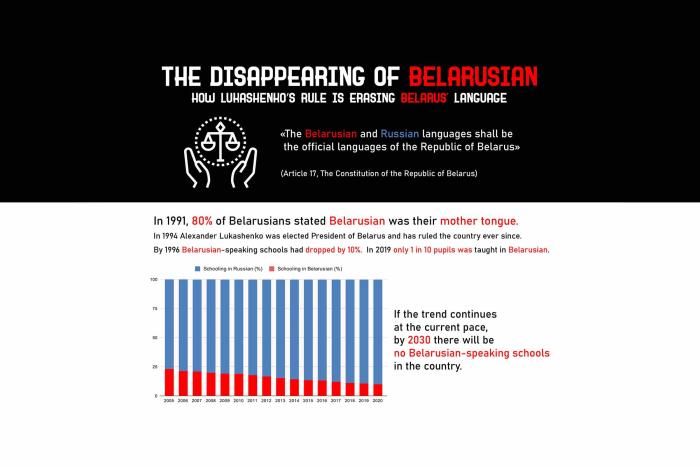
The official language of Belarus is Belarusian. It holds co-official status with Russian. While the prevalence of Russian in public life and everyday communication is noteworthy, Belarusian remains a vital part of the country’s cultural heritage. Regional variations exist, primarily in pronunciation and vocabulary, but these differences are not so significant as to impede mutual intelligibility. Official documents and government communications are required to be in Belarusian, underscoring its legal standing.
History of the Belarusian Language
The history of the Belarusian language stretches back centuries, shaped by various political and cultural influences. The 14th to 16th centuries witnessed the development of Middle Belarusian, a period marked by significant linguistic shifts, particularly from the incorporation of elements from neighboring East Slavic languages. The 17th and 18th centuries, characterized by periods of political upheaval, further influenced the language.
A key factor was the increasing dominance of Russian, leading to the integration of Russian vocabulary and grammatical structures into Belarusian. The 19th and 20th centuries saw further transformations, particularly with the rise of modern Belarusian literature and the subsequent political suppression of the language during Soviet times. This period of suppression, coupled with the prevalence of Russian, contributed to the decline in the use of Belarusian.
Language Family
Belarusian belongs to the East Slavic branch of the larger Slavic language family. Key features of the East Slavic branch include a shared grammatical structure, a common vocabulary base, and the existence of significant regional variations. Belarusian, Russian, and Ukrainian, despite their differences, share a deep historical connection, evident in their common ancestry and overlapping vocabulary.
Relationship with Other Slavic Languages
Belarusian shares significant similarities with Russian and Ukrainian, reflecting their common origin and historical interactions. Cognates, words with shared roots and similar meanings, are abundant across these languages. However, distinctions exist in vocabulary and grammar. For example, while the word for “house” is similar across all three languages, nuanced differences in grammatical structures like noun declensions and verb conjugations exist.
Comparison with Russian and Ukrainian
Belarusian differs from Russian and Ukrainian in vocabulary and grammar. The noun declension patterns are distinct, with Belarusian possessing a more complex system than Russian. Verb conjugations also exhibit variations. For instance, the use of prefixes and suffixes in verb conjugation differs. Furthermore, significant loanwords from Russian and other languages exist in Belarusian, while Russian and Ukrainian have borrowed vocabulary from other languages as well.
Distinctive Linguistic Features
Belarusian possesses unique grammatical cases and complex noun declensions, reflecting its historical development. Its pronunciation features are also distinctive, with certain sounds differing from Russian and Ukrainian. The evolution of vocabulary items also exhibits specific characteristics, demonstrating the language’s resilience and adaptability.
Belarussians, it would seem, primarily communicate in Belarusian. However, a fascinating parallel can be drawn to the linguistic traditions of the past. Intriguingly, learning about the language of the Aztecs, as detailed in this illuminating piece what language did aztecs speak , reveals a rich tapestry of linguistic history. Ultimately, Belarusian remains the primary tongue of Belarus.
Common Belarusian Phrases
- Greetings:
- Добрай раніцы (Dobray ranicy)
-Good morning - Добрага дня (Dobrago dnya)
-Good day - Добрага вечара (Dobrago vechora)
-Good evening - Добрай ночы (Dobray nochy)
-Good night - Як справы? (Yak spravy?)
-How are you?
- Добрай раніцы (Dobray ranicy)
- Everyday Conversations:
- Я хачу (Ya hachu)
-I want - Мне трэба (Mnye treba)
-I need - Дзякуй (Dzyakuy)
-Thank you - Добры дзень (Dobry dzen)
-Good day - Да пабачэння (Da pabachenya)
-Goodbye
- Я хачу (Ya hachu)
- Expressions of Gratitude:
- Большае дзякуй (Bol’shae dzyakuy)
-Thank you very much - Дзякуй вялікі (Dzyakuy vyaliki)
-Thank you so much - Не за што (Ne za shto)
-You’re welcome - З задавальненнем (Z zadavalnennem)
-With pleasure - Нема за што (Nema za shto)
-You’re welcome
- Большае дзякуй (Bol’shae dzyakuy)
Role in Belarusian Culture
Belarusian plays a vital role in Belarusian culture. Its use in literature, media, and everyday life fosters a sense of cultural identity. Classic Belarusian literature, including works by renowned authors, showcases the language’s rich literary tradition. The use of Belarusian in media, including television and radio, contributes to its ongoing presence in society. Everyday conversations, especially in rural areas, demonstrate the language’s enduring relevance.
Belarusians, it would seem, predominantly speak Belarusian. However, a fascinating parallel can be drawn to the linguistic landscape of Saudi Arabia, where the official tongue is Arabic. To delve deeper into this fascinating linguistic diversity, one might consult this helpful resource: what language do saudi arabia speak. Ultimately, Belarusian remains the primary tongue of Belarus, a fact often overlooked in these linguistic explorations.
Evolution of Belarusian
| Historical Period | Key Features | Example Vocabulary Changes | Example Grammatical Shifts |
|---|---|---|---|
| Middle Belarusian (14th-16th centuries) | Emergence of distinct features | From
| Changes in case endings |
| Early Modern Belarusian (17th-18th centuries) | Increased Russian influence | Integration of Russian loanwords | Shift in verb conjugations |
| Modern Belarusian (19th-21st centuries) | Standardization and resurgence | Development of new words | Refinement of grammatical rules |
Timeline of Key Events
(A detailed timeline of key events would be presented here, including dates, political, social, and cultural impacts on the language.)
Comparison of Alphabets
| Alphabet | Unique Characters | Corresponding Sounds |
|---|---|---|
| Belarusian | (List of unique characters and corresponding sounds) | (Sounds for each character) |
| Russian | (List of unique characters and corresponding sounds) | (Sounds for each character) |
| Ukrainian | (List of unique characters and corresponding sounds) | (Sounds for each character) |
Language Usage and Distribution

Belarusian, a Slavic language, holds a significant place in the cultural fabric of Belarus. Its presence in everyday life, from rural villages to urban centers, is a testament to its enduring role in Belarusian society. Understanding its usage patterns and distribution sheds light on the intricate interplay of linguistic, political, and social forces that shape its presence today.The usage and distribution of Belarusian are complex and dynamic, influenced by historical events, political landscapes, and evolving social norms.
Factors such as education policies, media representation, and official recognition all play a role in shaping how the language is used in various contexts.
Examples of Belarusian Usage in Belarus
Belarusian is spoken in various settings across Belarus. In rural areas, it often serves as the primary language of communication in daily life. For example, in small villages and agricultural communities, Belarusian is frequently used in local markets, family gatherings, and interactions with neighbors. Within urban centers, such as Minsk, Belarusian is present, although Russian often takes precedence in formal settings.
Furthermore, Belarusian is employed in specific sectors like education and cultural events, depending on the context and target audience.
Geographical Distribution of Belarusian Speakers
The geographical distribution of Belarusian speakers in Belarus is not uniform. Higher concentrations of Belarusian speakers are generally observed in rural areas and smaller towns, while urban centers like Minsk often exhibit a higher proportion of Russian speakers. Historical migration patterns and population shifts have contributed to this disparity. Further, access to Belarusian-language media and educational opportunities can affect the prevalence of the language in specific regions.
Impact of Political and Social Factors on Belarusian Usage
Political and social factors have significantly influenced the use of Belarusian. Historically, periods of political suppression have negatively impacted the use of Belarusian in official contexts and public life. Conversely, periods of relative openness have allowed for the promotion and revitalization of the language. Social attitudes towards the language, alongside governmental policies and public perception, are essential factors in shaping its usage and distribution.
Role of Education in Preserving and Promoting the Belarusian Language
Education plays a critical role in preserving and promoting Belarusian. Educational institutions that provide instruction in Belarusian, and encourage its use within the classroom, foster linguistic fluency and cultural awareness. Moreover, the inclusion of Belarusian literature, history, and culture in the curriculum contributes to the language’s continued use and transmission across generations.
Challenges Faced by the Belarusian Language in the Modern World
The Belarusian language faces several challenges in the modern world. The dominance of Russian, both in formal and informal contexts, often presents a barrier to the widespread use of Belarusian. Additionally, the lack of consistent and comprehensive language support, in areas like media and official documentation, further hinders the language’s development and acceptance.
Statistics on Belarusian Speakers in Different Regions
Detailed statistics regarding the number of Belarusian speakers in different regions are available from various sources. However, exact figures can be difficult to obtain, particularly due to varying methodologies and definitions. Furthermore, surveys and studies often differ in their methods for language identification and assessment. In general, these figures are crucial to understand the language’s presence across the country.
Status of Belarusian in Official Contexts
The status of Belarusian in official contexts has fluctuated throughout history. While Belarusian is officially recognized as one of the national languages of Belarus, the extent of its use in official documentation, government communication, and public services varies. Furthermore, factors like administrative procedures, government initiatives, and policy decisions impact the language’s presence in official contexts.
Comparison of Belarusian Usage in Urban and Rural Areas
Belarusian usage tends to be more prevalent in rural areas compared to urban areas in Belarus. In rural communities, Belarusian is frequently used in daily interactions, while urban areas often experience more extensive use of Russian. This disparity highlights the role of geographical location, social norms, and cultural practices in language use.
Map Illustrating the Geographical Distribution of Belarusian Speakers
A map illustrating the geographical distribution of Belarusian speakers would show varying densities in different regions. High concentrations of speakers would be evident in rural areas and smaller towns. Conversely, lower concentrations would be seen in major urban centers. This map would visually represent the language’s geographical spread and provide a spatial context for understanding its use.
Use of Belarusian in Different Media
Belarusian is present in various media outlets, though its representation varies. News broadcasts, literary publications, and cultural events all contribute to the language’s presence in the media landscape. The diversity and range of media content reflect the language’s importance in disseminating information and fostering cultural expression.
Linguistic Variations
Belarusian, a Slavic language, exhibits significant linguistic variation across its geographical distribution. These variations, often categorized as dialects, reflect historical influences, geographical isolation, and social factors. Understanding these variations is crucial for appreciating the richness and complexity of the Belarusian language and for effective communication across different regions.
Identifying and Categorizing Belarusian Dialects, What language do belarus speak
Belarusian dialects are primarily differentiated by geographical location. Recognized major dialects include:
- Western Belarusian:
- Central Belarusian:
- Eastern Belarusian:
- Southern Belarusian:
These regional distinctions are based on established linguistic research, focusing on significant differences in vocabulary, grammar, and pronunciation.
Dialectal Differences: Vocabulary and Grammar
Variations in vocabulary and grammar across Belarusian dialects influence mutual intelligibility. The table below highlights key differences in three major dialects:
| Dialect | Nouns (declensions, gender agreement) | Verbs (conjugations, tense forms) | Adjectives (comparison forms, agreement) | Common Phrases/Idioms |
|---|---|---|---|---|
| Western Belarusian | Demonstrates a relatively consistent noun declension system compared to other dialects. However, some subtle differences exist in case endings. | Presents unique verb conjugations, particularly in the past tense and conditional forms. | Displays distinct comparative forms and agreement patterns with nouns. | Unique set of phrases, reflecting regional customs and expressions. |
| Central Belarusian | Shows a transition in noun declensions, combining features from Western and Eastern Belarusian. | Demonstrates a mixture of verbal conjugations from Western and Eastern Belarusian dialects, often exhibiting intermediate forms. | Adjective agreement patterns blend Western and Eastern Belarusian features. | Common phrases reflect the transition between Western and Eastern Belarusian expressions. |
| Eastern Belarusian | Displays a greater influence from Russian, with noticeable differences in noun declensions, particularly in case endings. | Demonstrates a stronger influence from Russian verb conjugations, particularly in tenses. | Shows similarities to Russian in adjective agreement patterns, particularly in the use of prefixes for comparison. | Frequently incorporates Russian phrases and idioms. |
These variations can affect the understanding of written texts from different regions. For example, a text written in Western Belarusian might use vocabulary and grammatical structures unfamiliar to a speaker of Eastern Belarusian.
Influence of Neighboring Languages
The influence of neighboring languages on Belarusian dialects is substantial. Polish, Russian, and Ukrainian have all contributed to Belarusian vocabulary, grammar, and pronunciation.
The influence of Polish is evident in the lexicon, with many loanwords related to culture, trade, and daily life. Russian has had a particularly strong influence on Eastern Belarusian, impacting both vocabulary and grammatical structures. Ukrainian, while less prominent, has contributed to certain lexical items and grammatical features in Southern Belarusian.
Evolution of Dialectal Variations
The evolution of Belarusian dialects is intertwined with historical events, migrations, and social factors.
The 18th to 20th centuries saw significant changes, influenced by political shifts and cultural exchanges. Documented changes include shifts in pronunciation, vocabulary, and grammatical structures. These shifts are often associated with periods of social and political upheaval.
Communication Implications
Dialectal variations in Belarusian impact communication between speakers from different regions. Differences in vocabulary, grammar, and pronunciation can create barriers to understanding.
Speakers often adapt their speech to be more easily understood by others from different regions, and this adaptation can involve the use of more standard Belarusian. The degree of mutual intelligibility varies depending on the dialects involved. Speakers from geographically close dialects may have greater mutual intelligibility than those from distant regions.
Pronunciation Guide (Table)
This table provides a general overview of pronunciation features. Specific pronunciation details are highly contextual and vary based on the specific dialect and local customs. Examples given are illustrative and not exhaustive.
| Dialect | Key Pronunciation Features | Example Word (and pronunciation) |
|---|---|---|
| Western Belarusian | Emphasis on “i” and “y” sounds | “dzieci” (dee-chee) |
| Central Belarusian | Distinct vowel sounds | “dźvia” (dzya) |
| Eastern Belarusian | Influence of Russian pronunciation | “malady” (ma-la-dee) |
Language and Literature

Belarusian literature, interwoven with the very fabric of the Belarusian language, plays a crucial role in preserving and propagating the language’s unique character. The rich tapestry of stories, poems, and essays woven by Belarusian authors reflects the nation’s history, cultural values, and aspirations. This literary heritage serves as a testament to the enduring spirit of the Belarusian people.Belarusian literature, far from being a static collection of historical texts, continues to evolve and adapt to modern sensibilities.
Contemporary writers engage with contemporary issues, mirroring the experiences and concerns of the Belarusian people in the 21st century. The vibrant interplay between tradition and innovation ensures that Belarusian literature remains a living force, capable of resonating with readers across generations.
Importance of Belarusian Literature in Preserving the Language
Belarusian literature acts as a vital repository of the language, safeguarding its vocabulary, grammar, and stylistic nuances. The use of the Belarusian language in literary works across centuries, from historical chronicles to modern prose, reinforces its usage and ensures its continued transmission. Through literature, the language gains a voice and vitality, which is critical in preserving it.
Role of Belarusian Writers and Poets
Belarusian writers and poets are the custodians of the literary tradition. Their creative endeavors, from meticulously crafted poems to intricate narratives, showcase the beauty and power of the Belarusian language. The unique perspectives and voices of these writers contribute to the diverse and rich landscape of Belarusian literature.
History of Belarusian Literature
Belarusian literature boasts a history spanning centuries, reflecting the evolving social and political landscape of the nation. From early folk tales and oral traditions to the works of modern authors, the evolution of Belarusian literature reflects the nation’s resilience and cultural identity. The history of Belarusian literature is a testament to the literary spirit of the Belarusian people.
Famous Belarusian Literary Works
Numerous literary masterpieces have emerged from the Belarusian literary tradition. These works range from historical chronicles detailing past events to contemporary narratives exploring contemporary issues. Notable examples include “The Belarusian Chronicles” (Літоўскія летапісы), showcasing the early historical accounts, and contemporary novels and poems that explore the modern world.
Impact of Belarusian Literature on Belarusian Identity
Belarusian literature plays a significant role in shaping the collective identity of the Belarusian people. The themes, characters, and narratives within these literary works reflect the experiences, values, and aspirations of the Belarusian community. The literary tradition deeply connects individuals to their cultural heritage and national identity.
Timeline of Significant Belarusian Literary Works and Their Authors
A comprehensive timeline outlining significant Belarusian literary works and their authors reveals the chronological development of the literary tradition. This timeline allows readers to trace the evolution of Belarusian literature, appreciating the contributions of various authors throughout history.
Themes Explored in Belarusian Literature
Belarusian literature explores a wide range of themes, including historical accounts, social commentary, and personal narratives. These themes often reflect the socio-political realities faced by the Belarusian people. The literary works offer diverse perspectives, enabling readers to connect with the nation’s history and culture.
Role of Translation in Promoting Belarusian Literature
Translation plays a crucial role in bringing Belarusian literature to a wider global audience. By translating these works into other languages, the literary richness and cultural insights are made accessible to a global readership. This process promotes intercultural understanding and fosters appreciation for Belarusian culture.
Use of Belarusian Language in Modern Literary Works
Contemporary Belarusian writers use the Belarusian language in their literary works to address modern themes and concerns. This showcases the ongoing relevance and adaptability of the Belarusian language in the literary sphere. The use of the Belarusian language in modern literature ensures its continuation and evolution.
Language Learning and Resources
Belarusian, a Slavic language spoken primarily in Belarus, presents a unique linguistic challenge for English speakers. This section provides a comprehensive guide to navigating the complexities of Belarusian language acquisition, focusing on available resources, learning methodologies, and the potential difficulties.Learning Belarusian involves understanding its unique grammatical structures and pronunciation, which differ significantly from English. This guide aims to equip learners with the necessary tools and insights to embark on this linguistic journey effectively.
Belarusian Language Learning: A Comprehensive Guide
Detail Resources for Learning Belarusian
A plethora of resources are available to aid in Belarusian language learning. Online courses, language exchange platforms, and mobile applications provide diverse learning avenues, catering to varying proficiency levels. For English speakers, resources specifically designed to bridge the gap between English and Belarusian grammar and pronunciation are invaluable.
- Online Courses (Beginner-Advanced): Platforms like Coursera, edX, and FutureLearn offer Belarusian language courses, providing structured lessons, exercises, and assessments. These are particularly helpful for structured learning and often feature recorded lectures and interactive quizzes.
- Language Exchange Platforms (Beginner-Intermediate): Platforms like HelloTalk and Tandem connect learners with native Belarusian speakers for conversational practice. These platforms offer opportunities for personalized feedback and cultural exchange, though consistency and quality of interaction may vary.
- Language Learning Apps (Beginner-Intermediate): Duolingo, Babbel, and Memrise are examples of language learning apps with Belarusian components. While not always exclusively focused on Belarusian, these apps provide a supplementary resource for vocabulary acquisition, basic grammar, and pronunciation practice. They often offer gamified learning experiences and can be beneficial for reinforcing learned material. However, they may not always provide in-depth grammatical explanations.
Difficulty of Learning Belarusian for Native English Speakers
The linguistic divergence between English and Belarusian presents both challenges and opportunities. Significant differences exist in pronunciation, grammar, and vocabulary, making Belarusian acquisition more demanding than some other Slavic languages.
- Pronunciation: Belarusian utilizes a distinct set of sounds and phonetic structures, potentially requiring dedicated practice to achieve accurate pronunciation. The use of Cyrillic script also requires a shift in writing habits.
- Grammar: Belarusian grammar, while sharing some Slavic similarities, deviates from English structure. This includes nuances in verb conjugations, noun declensions, and sentence structure.
- Vocabulary: While some cognates exist, a substantial portion of Belarusian vocabulary is unique, requiring memorization and immersion in the language’s context.
Estimating the time required to achieve fluency depends on factors like prior language learning experience, frequency of study, and individual learning styles. For a beginner with no prior Slavic language background, attaining basic conversational proficiency could take several months, while fluent reading and writing may take several years.
Online Resources for Learning Belarusian
Numerous reputable online resources facilitate Belarusian language learning.
- Learn Belarusian (Website): A comprehensive grammar guide and vocabulary builder, suitable for intermediate to advanced learners. Strengths: Detailed explanations and exercises. Weaknesses: May be too advanced for beginners.
- Belarusian Language Learning Resources (Website): A repository of online resources, including grammar explanations, vocabulary lists, and audio pronunciation guides. Strengths: Extensive resource library. Weaknesses: Organization and structure may be inconsistent.
- Belarusian Language Exchange (Website): A platform for language exchange with native speakers. Strengths: Provides opportunities for conversational practice. Weaknesses: May not offer structured learning paths.
- Belarusian-English Dictionary (Website): An online dictionary with translation tools and definitions. Strengths: Facilitates vocabulary acquisition. Weaknesses: May lack detailed grammatical explanations.
- YouTube Channels (Various): Numerous Belarusian language learning channels provide video tutorials, grammar explanations, and conversational examples. Strengths: Visual and auditory aids. Weaknesses: Quality and consistency may vary.
Ending Remarks
So, basically, Belarus speaks Belarusian. It’s a Slavic language with a ton of history and cultural significance. It’s also got some serious regional variations, and it’s been influenced by its neighbors. Learning about the language is like unlocking a whole new world of Belarusian culture. It’s pretty cool, tbh.
Question & Answer Hub
What’s the difference between Belarusian and Russian?
They’re both Slavic languages, but Belarusian has its own unique grammar and vocabulary. Think different verb conjugations and noun declensions. It’s like, totally different, even though they have some shared words.
Is Belarusian difficult to learn for English speakers?
Yeah, it can be tough. The grammar is pretty different from English, and the pronunciation can be tricky too. But if you put in the work, you can totally do it! It’s like any other language, just gotta keep practicing.
Where is Belarusian spoken besides Belarus?
Mostly in Belarus, but there are smaller communities of Belarusian speakers elsewhere, too. It’s not as common as in Belarus itself, but it’s still spoken by people in different parts of the world.
What are some resources for learning Belarusian?
There are online courses, language exchange platforms, and apps. Look for ones specifically for English speakers. It’s like, do your research and find something that works for you.
